

The Pan American Health Organization (PAHO) recently published a new report on Alcohol and Health in the Americas (2025),¹ compiling WHO (2024) data on alcohol consumption, mortality, and alcohol-related harms across 35 countries in the region. The document warns that alcohol continues to be a major preventable risk factor for disease, violence, and premature death, while also highlighting that public control policies are still progressing too slowly and insufficiently in light of the severity of the problem in the Americas.
According to the new PAHO report, the Americas remain among the regions with the highest alcohol consumption in the world. The region maintains an average consumption of more than 7 liters of pure alcohol per capita per year, ranking second globally behind only Europe.
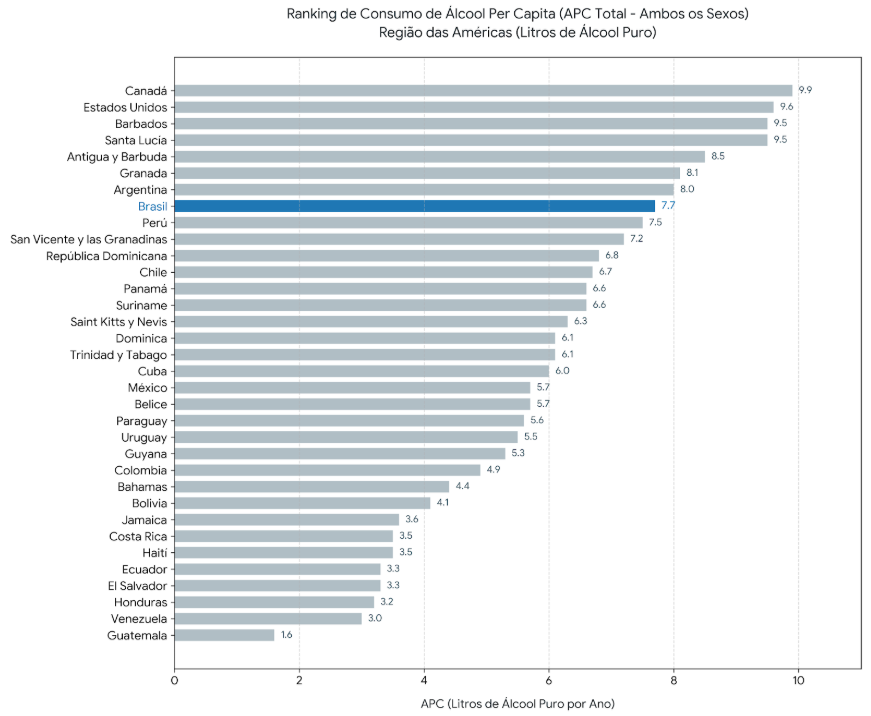
The data also show that more than 60% of the adult population in the region regularly consumes alcoholic beverages. Among the countries with the highest per capita consumption are Canada (9.9 liters), the United States (9.6 liters), and Barbados (9.5 liters). Brazil ranks eighth (7.7 liters).
The pattern of heavy episodic drinking (binge drinking) is also concerning. In 2019, the average prevalence of binge drinking episodes in the general population of the Americas was 25.7%, reaching 35.9% among men and 15.8% among women.
Among adolescents aged 15 to 19, the situation is particularly alarming: alcohol consumption prevalence reached 41.9%, making the Americas the region with the second-highest alcohol consumption in this age group worldwide. The report states that these numbers are “unacceptably high,” especially considering the risks to brain and neurocognitive development and the existence of laws prohibiting alcohol sales to minors.
Another relevant finding is the predominance of beer as the most consumed alcoholic beverage in the Americas: it accounts for 53.8% of recorded alcohol consumption in the region, a proportion higher than in any other WHO region.
The PAHO report reinforces that alcohol is associated with more than 200 health conditions, including cardiovascular diseases, cancers, liver cirrhosis, mental disorders, violence, and traffic accidents.
In the Americas, alcohol consumption was responsible for approximately 385,354 deaths in 2019, including 318,412 among men and 66,942 among women.
The burden of alcohol-attributable disease also remains high. The region recorded 32.7 deaths and 1,747 disability-adjusted life years (DALYs) lost per 100,000 inhabitants, placing the Americas among the most affected regions in the world.
Among the main alcohol-related harms are:
The document also highlights that the impact of alcohol extends beyond individual health, affecting families, communities, economic productivity, and global sustainable development goals.
Among the report’s central recommendations is strengthening the so-called SAFER policies, the WHO technical package aimed at reducing harmful alcohol use. In this context, PAHO highlights higher taxes and minimum pricing policies as some of the most cost-effective interventions available to governments.
According to the report, fiscal policies reduce the economic affordability of alcoholic beverages, especially among young people and groups more vulnerable to harmful consumption. In addition, such measures can generate additional revenue for public health investments and prevention programs.
Despite this, adoption of these measures remains limited across the Americas. Many countries still maintain outdated tax structures without inflation adjustments or mechanisms capable of effectively reducing consumption.
Regarding Brazil, the data show that the country remains above the global average in alcohol consumption, recording 7.7 liters of pure alcohol per capita in 2019.
In addition, according to the report:
The document also projects growth in Brazilian alcohol consumption through 2030, reinforcing the need to strengthen public prevention and regulatory policies.
The data presented by PAHO reinforce that harmful alcohol consumption remains one of the greatest public health challenges in the Americas. The combination of high consumption prevalence, early initiation, easy access, and still-insufficient regulatory policies contributes to the persistence of a high burden of preventable diseases and deaths.
In this context, expanding access to high-quality scientific information and strengthening evidence-based policies become essential measures to reduce harm, protect vulnerable populations, and support public health decision-making.
References:
Organização Pan-Americana da Saúde (OPAS). Informe sobre la situación del alcohol y la salud en la Región de las Américas 2025. Washington, DC: OPAS; 2025. Disponível em: OPAS. Acessed: May 22, 2026.